
Separation Anxiety Training: How to Leave Your Dog Alone Without Guilt
You pick up your keys and your dog's ears snap up. By the time you touch the doorknob, the whining has started. An hour later, a neighbor texts you a video: your dog has been howling since you left, and the door frame has new teeth marks. If this is your house, this guide is for you — separation anxiety is one of the most common canine behavior problems, and one of the most fixable.
First: Is It Really Separation Anxiety?
Dogs destroy things for lots of reasons — boredom, excess energy, puppy teething. True separation anxiety has a specific signature: distress that begins when you're about to leave or shortly after, and only when the dog is alone. The classic signs:
- Whining, howling or barking that starts within minutes of your departure (your neighbors will confirm)
- Destructive chewing focused on exit points — doors, door frames, window sills — not random items
- House soiling from an otherwise house-trained dog, only when alone
- Pacing, panting and drooling in the minutes before you leave
- Over-the-top hellos and clingy "shadow" behavior when you're home
If your dog relaxes in another room while you're home but falls apart when alone, that's the pattern. If they destroy the couch whether you're home or not, you probably have a boredom problem — which is easier (more exercise and enrichment will fix it, start here).
Why Punishment Makes It Worse
The single most important thing to understand: your dog is not misbehaving — they're having a panic attack. Separation anxiety is a clinical distress response, not spite or dominance. Yelling at a dog when you come home to damage teaches them one thing: your returns are unpredictable and scary. It deepens the anxiety and adds fear of you on top of fear of being alone.
For moderate-to-severe cases, a certified veterinary behaviorist is worth the money. But most mild-to-moderate cases respond well to the training plan below — done properly, it succeeds in the majority of dogs.
The Training Plan: Systematic Desensitization
The core idea is simple: teach your dog, in tiny steps, that your departures predict your returns, and alone-time is boring and safe. You never push past the point where distress begins. Here's the framework.
Step 1: Kill the departure cues (days 1–7)
Your dog has learned a script: keys = abandonment. So break the script. Pick up your keys and sit back down. Put on your shoes and watch TV. Grab your bag, walk to the door, then walk away and make coffee. Repeat, randomly, 10-15 times a day for a week. Within days, most dogs stop reacting — the cues have lost their meaning. This alone reduces pre-departure panic dramatically.
Step 2: Micro-departures (weeks 1–2)
Now leave for seconds at a time. Open the door, step out, close it, come back in — before any whining starts. The golden rule: always return before your dog gets upset. If you come back to crying, you went too long; halve the duration next time. Progress looks like: 5 seconds → 15 → 30 → 1 minute → 2 → 5. Some dogs move through this in a week; anxious ones need a month. Slow is fast.
Step 3: Build to real absences (weeks 2–6)
Once your dog is calm for 5-10 minutes alone, stretch toward real-world durations: 15, 30, then 60 minutes. Mix short absences into the rotation — five 10-minute sessions beat one 50-minute push. Track your durations in a note. When you hit 60 calm minutes, most dogs generalize: alone is fine.
Step 4: Make alone-time genuinely good
Now layer in positive associations. A departure-only goodie — a stuffed frozen Kong, a puzzle feeder, a handful of kibble hidden in a snuffle mat — appears only when you leave and vanishes when you return. Many anxious dogs go from "panicking by the door" to "hoping you'll leave" once the alone-menu includes a hunting game. (One caution: severely anxious dogs may not eat when panicked — if the food goes untouched, drop back to shorter absences.)
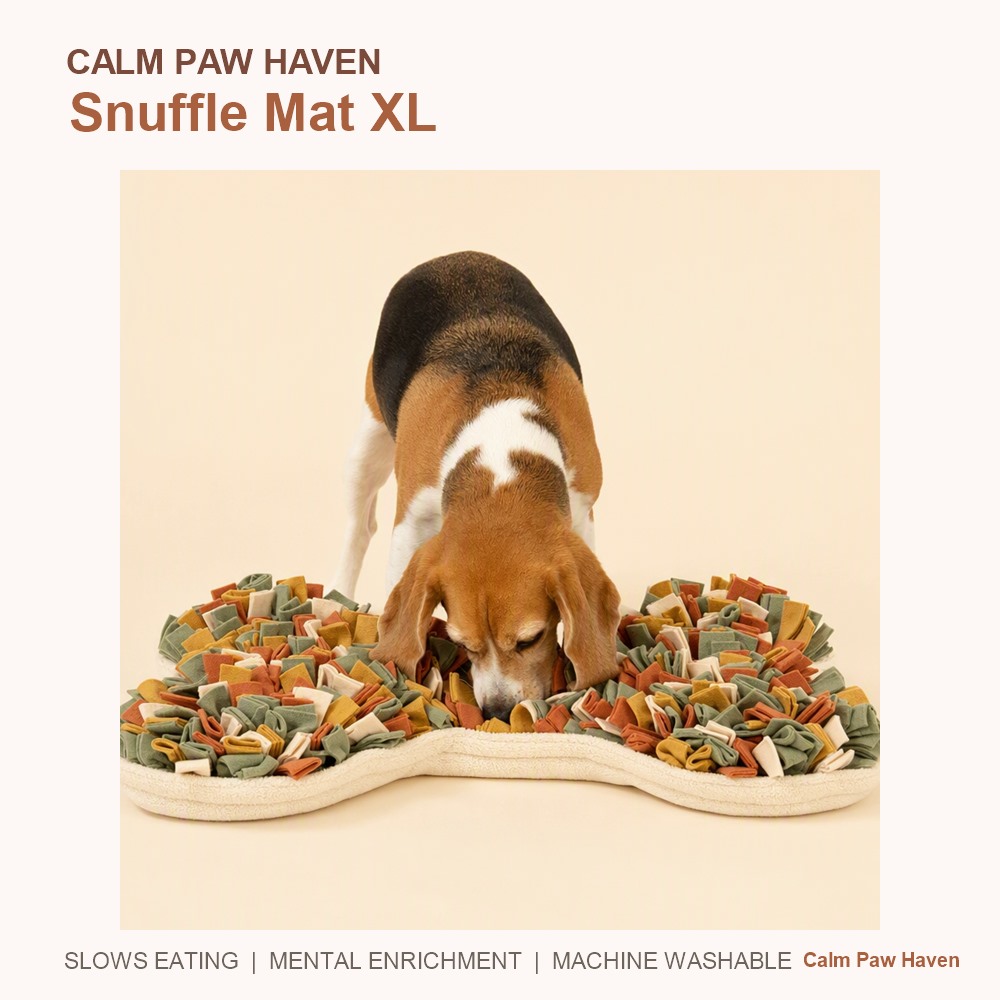
Departure Tool: Flower Snuffle Mat
Fifteen minutes of foraging at the start of every absence. A busy nose can't panic — sniffing measurably lowers canine heart rate. Learn more →
The Tools That Actually Help (and What to Skip)
Tools don't cure separation anxiety — training and time do. But the right tools make the plan faster and the wrong ones make it worse.
- Scent and sound comfort: an item that carries your smell, plus a simulated heartbeat, gives many dogs a focal point for calm instead of the door. The heartbeat mimics the littermate warmth that puppies sleep against — it's the closest thing to "you're not really gone."
- Long-lasting food puzzles: frozen Kongs, snuffle mats, treat balls. The first 15 minutes of an absence are the most volatile; occupy them.
- A camera: a cheap indoor camera is non-negotiable for tracking progress. You cannot train what you cannot see. Watch for pacing, drooling, and where the distress peaks.
- Skip the bark collars. Suppressing the symptom without treating the cause adds pain to panic. It can produce quiet dogs who still destroy the door frame — now too scared to cry about it.
- Use the crate carefully. For dogs who already love their crate, it can be a safe den. For dogs with separation anxiety, confinement often amplifies panic and leads to injured teeth and nails. Test with the camera before trusting it.
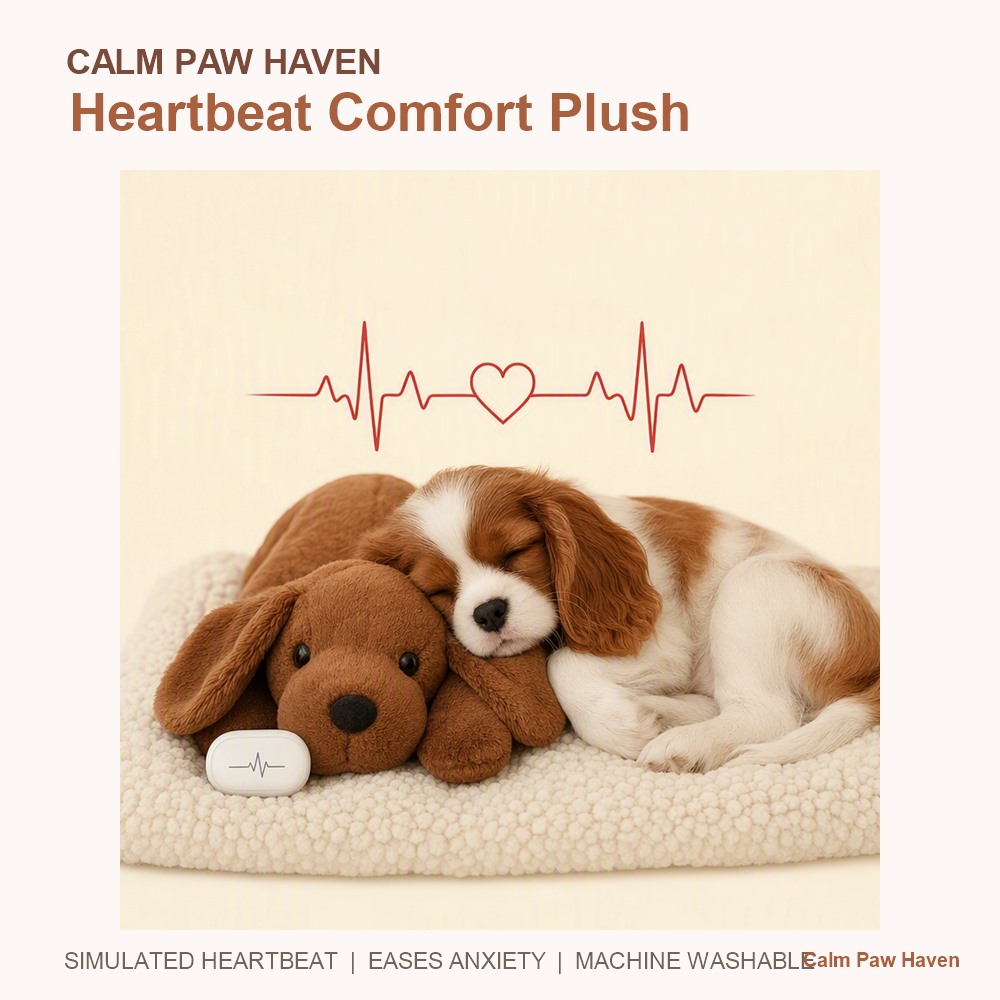
Calm-Down Companion: Heartbeat Comfort Plush
A soft plush with a realistic simulated heartbeat. Give it to your dog at every departure so "alone time" comes with a warm, beating friend. Learn more →
Realistic Expectations
Mild cases often resolve in 3-6 weeks of consistent work. True clinical separation anxiety can take 3-6 months, and severe cases benefit from professional help — a veterinary behaviorist may combine the training plan with short-term anti-anxiety medication to get the dog under threshold so learning can happen. That's not cheating; it's giving the training a chance to work.
Expect setbacks after disruptions — travel, illness, a new schedule mean you briefly drop back a step or two. That's normal, not failure.
The Bottom Line
Separation anxiety is a solvable problem with an unglamorous solution: hundreds of tiny, boring successful repetitions. Break the departure cues, leave for seconds before stretching to hours, make alone-time worth looking forward to, and film everything. One day you'll pick up your keys and your dog won't even look up — and that's the goal.