
Why Is My Hamster Active at Night? Nocturnal Habits Explained
You got a hamster to watch during the day, but yours seems to sleep through every afternoon — then sprints on the wheel, digs, and rearranges bedding at 2 a.m. Nothing is wrong. Your hamster is simply doing what millions of years of evolution programmed: being a nocturnal (technically crepuscular) animal. Here's the science, and how to make night-time work for both of you.
Hamsters Aren't Lazy — They're on a Different Schedule
In the wild, Syrian and dwarf hamsters are most active at dusk and dawn (crepuscular), when desert predators are fewer and temperatures cooler. Their eyes are built for low light, their hearing and smell are superb, and their internal clock runs roughly opposite to yours. A hamster sleeping all day isn't depressed or sick — it's a healthy animal following its biology.
How Far Does a Hamster Actually Run at Night?
The number surprises most owners: studies have recorded hamsters running the equivalent of 5-9 kilometers (3-5+ miles) per night on a wheel. That's astonishing for an animal that fits in your palm — like a human jogging a marathon every evening. This isn't optional exercise, either: wheel running releases stress and satisfies a migration instinct hamsters still carry. A hamster without a wheel can develop cage pacing and stress behaviors. The wheel isn't a toy — it's essential equipment.
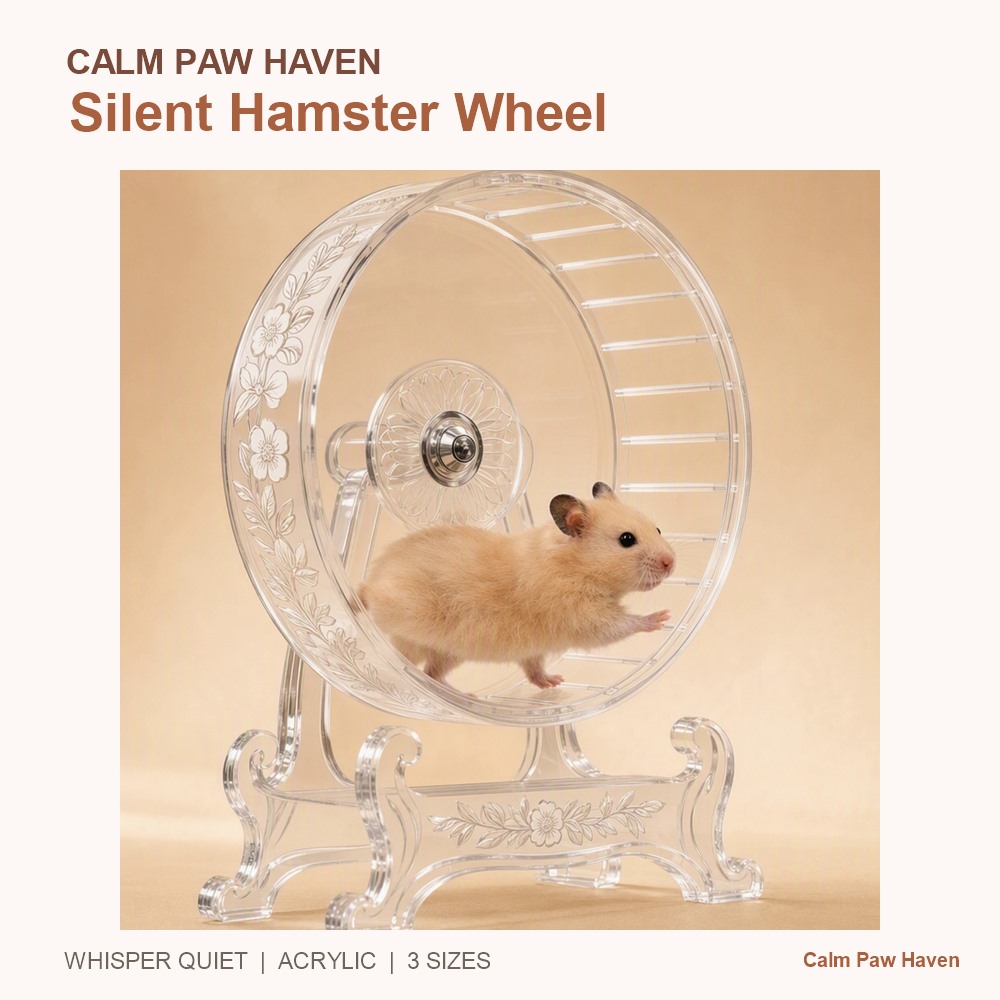
Silent Acrylic Hamster Wheel
Whisper-quiet sealed bearings under 20dB, seamless acrylic surface in 3 sizes — so your hamster runs their nightly miles while you sleep. Learn more →
The Real Problem: Noisy Wheels (and the Fix)
Since the wheel is non-negotiable, the question becomes: how do you sleep through it? Cheap wheels squeak for three reasons: metal-on-metal axles, warped plastic, and mesh rungs that clatter. Solutions, in order of impact:
- Sealed bearing wheels: a quality wheel with enclosed bearings runs at under 20dB — quieter than a whisper from across the room
- Solid running surface: no mesh rungs (also safer for tiny feet — no caught toes)
- Correct size: too-small wheels force an arched back and noisy scurrying; dwarfs need ~24cm, Syrians ~28cm+
- Placement: keep the habitat out of your bedroom if noise is still an issue — the simplest fix of all
Other Night Behaviors, Decoded
- Frantic digging/burrowing: normal nesting instinct — offer deep bedding (15cm+) and they'll dig happily rather than obsessively
- Gnawing the bars: often boredom or a too-small enclosure; upgrade space and add chew toys
- Food hoarding: cheeks stuffed with seeds = a hamster having a great day. Let them cache food; it's deeply reassuring behavior for them
- Zoomies in the ball or playpen: great enrichment, if supervised and sessions are short
Should You Wake a Sleeping Hamster?
Try not to. A hamster startled awake can be defensive (nips) and repeatedly disturbed sleep stresses the immune system. If you want interaction, schedule it for early evening — around sunset — when your hamster naturally wakes. Offer a treat from your open palm, let them climb on, and keep sessions gentle. Daytime handling should be rare and calm.
A Healthy Night Routine for Your Hamster
- Feed in the evening, not morning — matches their active period and prevents food sitting stale all day
- Deep bedding + a hideout for daytime darkness and undisturbed sleep
- A silent wheel sized correctly for your species
- Chew items rotated weekly — nighttime gnawing keeps teeth healthy
The Takeaway
A hamster awake all night is a hamster living its best life. Your job isn't to change their schedule — it's to support it: a proper silent wheel, deep bedding, evening feeding, and respect for daytime sleep. Do that, and you'll both get a good night's rest (well — one of you will).
Small pet questions? Message us — we reply within 24 hours.